|
|
| Placeholder CPT |
Clinical Service |
Proposed Work RVU | Proposed Total RVU | Proposed National Payment |
|
92654 |
Treatment of fluency disorder (eg, stuttering and cluttering), direct (one-on-one) patient contact; initial 30 minutes |
0.92 |
1.60 |
$54.55 |
|
+92655 |
Treatment of fluency disorder; each additional 15 minutes (list separately in addition to the primary code) |
0.44 |
0.73 |
$23.97 |
|
92656 |
Treatment of speech sound production disorder (eg, articulation, phonological process, apraxia, dysarthria), direct (one-on-one) patient contact; initial 30 minutes |
0.90 |
2.01 |
$66.01 |
|
+92657 |
Treatment of speech sound production disorder; each additional 15 minutes (list separately in addition to the primary code) |
0.44 |
0.73 |
$23.97 |
|
92658 |
Treatment of language comprehension and expression disorder (eg, receptive and expressive language), direct (one-on-one) patient contact; initial 30 minutes |
1.00 |
1.52 |
$49.92 |
|
+92659 |
Treatment of language comprehension and expression disorder; each additional 15 minutes (list separately in addition to the primary code) |
0.48 |
0.70 |
$22.99 |
|
92660 |
Treatment of speech sound production disorder and language comprehension and expression disorder, direct (one-on-one) patient contact; initial 30 minutes |
1.00 |
2.18 |
$71.59 |
|
+92661 |
Treatment of speech sound production disorder and language comprehension and expression disorder; each additional 15 minutes (list separately in addition to the primary code) |
0.50 |
0.85 |
$27.91 |
|
92662 |
Treatment of voice, upper airway dysfunction, and/or resonance disorders, direct (one-on-one) patient contact; initial 30 minutes |
0.98 |
1.67 |
$54.84 |
|
+92663 |
Treatment of voice, upper airway dysfunction, and/or resonance disorders; each additional 15 minutes (list separately in addition to the primary code) |
0.48 |
0.73 |
$23.97 |
Group Treatment
CPT code 92508 will continue to be an untimed code for group treatment.
Unlike the current code set, 92508 will function as a stand-alone code rather than being linked to the individual treatment code.
CMS has also proposed a HCPCS G Code for pediatric populations:
HCPCSG Code |
2027 Descriptor |
Proposed Work RVU | Proposed PE RVU | Proposed MP RVU | Proposed Total RVU | Medicare Rate |
| GSLPP | Pediatric treatment of speech, language, voice, communication, and/or auditory processing disorder; individual | 1.3 | 0.71 | 0.01 | 2.02 | $66.34 |
Important: Do not start using the new codes early. Continue using 92507 through December 31, 2026, unless a payer specifically directs otherwise.
Why Should Pennsylvania SLPs Care?
Because a coding change can become a payment change.
The CPT code tells a payer what service was provided. It does not automatically determine what that service will be paid. PSHA should monitor the transition at three levels.
FEDERAL — CMS / Medicare
What will Medicare pay for the new codes?
PENNSYLVANIA MEDICAID
Will Pennsylvania Medicaid adopt the new codes? When? At what rates?
COMMERCIAL PAYERS
Will each payer adopt the new codes, and how will reimbursement be established?
92507 Timeline
2024 → 92507 flagged for review
2025–2026 → CPT review and new code development
2026 → RUC valuation and CMS proposal
***September 2026 → CMS public comment period
Fall 2026 → Final 2027 CPT information becomes available
December 31, 2026 → LAST DAY FOR 92507
January 1, 2027 → NEW CODES BEGIN FOR MEDICARE
PSHA Recommendations
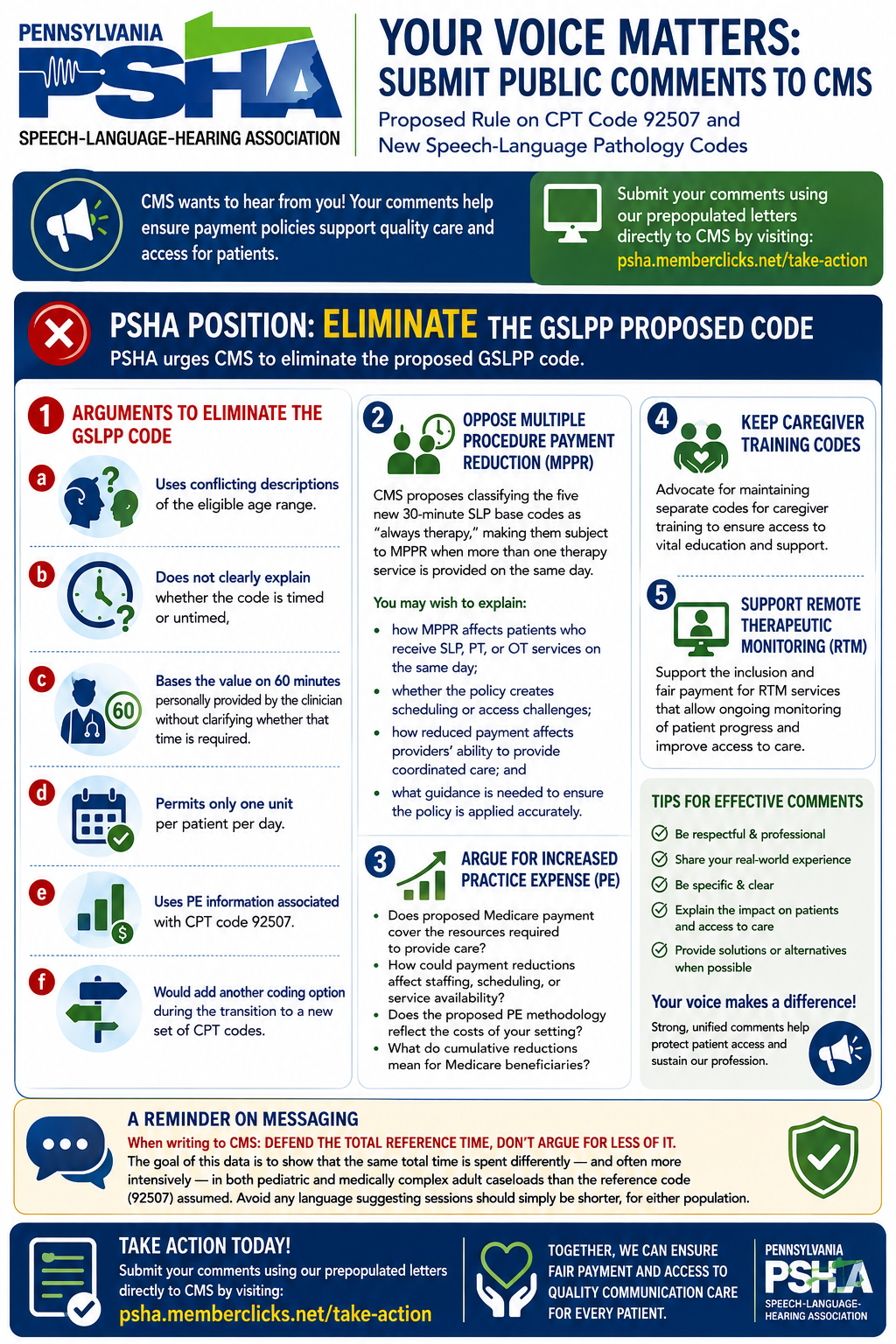
CMS Comment Resources
ASHA Resources
- Code by Code Series
- Readiness Checklist
-
Understanding Medicare’s Proposal and Preparing for the 92507 Change Webinar
PSHA 3P’s On A Pod; PSHA Perspectives on 92507
Episode 1: PSHA Perspectives on 92507
Why 92507 was reviewed, what happened during the CPT process, and why the code is changing.
LISTEN NOW
Episode 2: CMS 92507 Comment
Prepare your CMS comments on the proposed 92507 changes.
LISTEN NOW
Upcoming 92507 Events
PSHA is preparing you for January 1.
92507 Town Hall
October 7, 2026 at 6:00- Virtual
Watch the recording
Join us for PSHA’s annual town hall. Learn about PSHA, what we have to offer and current legislation we are tracking in PA. Immediately after the annual town hall will be a 92507 presentation and opportunities for discussion with other PA SLP’s to help you prepare for the upcoming change. Participation is free and open to both members and nonmembers.
Understanding the New CPT Codes- November
Date: November 16th, 2026 at 7pm
Code structure, timed billing, documentation, EHR/billing preparation, and common questions.
Payer Update & Q&A- December
Date: December 10th, 2026 at 7pm
Latest information from Pennsylvania Medicaid and commercial insurers.
Pennsylvania Payer Implementation Tracker
What is YOUR payer doing?
|
Payer |
Adopting New Codes? |
Effective Date |
Reimbursement Information |
PSHA Status |
|
PA Medicaid |
Possibly. PSHA and ASHA met with PA’s Medicaid Director to discuss the codes. Their office will review when the final rule is adopted. |
Any possible changes will not take effect until March 2027 AT THE EARLIEST |
The current fee schedule will stay in place until at least March. Medicaid is considering the change. |
Regular meetings and contacts with Secretary Arkoosh and Sally Kozad, Medicaid Director for PA |
|
UPMC Health Plan |
Awaiting confirmation |
TBD |
TBD |
Monitoring |
|
Highmark |
Awaiting confirmation. The Tri Alliance has regular contact with Highmark. Highmark contact says they will make a decision in October once CMS has announced the final rule. |
TBD |
TBD |
Regular meetings with Tri Alliance and will meet with SLP Director at Highmark in October. |
|
Independence Blue Cross |
Awaiting confirmation |
TBD |
TBD |
Monitoring |
|
Aetna |
Awaiting confirmation |
TBD |
TBD |
Monitoring |
|
Cigna |
Awaiting confirmation |
TBD |
TBD |
Monitoring |
|
UnitedHealthcare |
Awaiting confirmation |
TBD |
TBD |
Monitoring |
|
Geisinger |
Awaiting confirmation |
TBD |
TBD |
Monitoring |
|
Jefferson |
Awaiting confirmation |
TBD |
TBD |
Monitoring |
Status Legend:
-
GREEN — Confirmed: payer has provided written implementation guidance.
-
YELLOW — Awaiting confirmation: PSHA has contacted the payer or is monitoring for guidance.
-
RED — Action needed: PSHA has identified a concern requiring member attention.
-
Purple — No information available: no verified payer guidance has been located.
REPORT A PAYER UPDATE
If you have received confirmation from a payer, please let PSHA know by emailing [email protected].
Disclaimer: Payer information represents information verified by PSHA at the time of publication. Policies may change. Providers should confirm billing requirements directly with their payer before submitting claims.=
SLP Preparation Checklist
☐ Keep using 92507 through December 31, 2026, unless a payer provides different instructions.
☐ Learn the new code structure and timed billing model.
☐ Contact your payers and ask about implementation and reimbursement.
☐ Talk to your billing team.
☐ Talk to your EHR vendor and confirm when the new codes will be available.
☐ Watch the PSHA payer tracker.
☐ Participate in advocacy and CMS public comments.
Frequently Asked Questions
Is 92507 going away?
Yes. CPT 92507 is scheduled to be deleted effective January 1, 2027 for Medicare.
Can I use the new codes now?
No. The new code structure is for services beginning January 1, 2027.
Does this automatically change what Medicaid pays?
No. Medicaid does not follow the Medicare schedule. See the Payer Implementation Tracker for updates on Medicaid.
Will every insurance company use the new codes?
Payers will establish their own implementation policies. This means that other payers are not obligated to adopt the new code structure. They also are not required to stick to the January 1, 2027 roll-out that Medicare is proposing. PSHA will track Pennsylvania payer responses.
Will the new codes pay more than 92507?
There is no single answer. Payment will depend on the payer, setting, and finalized fee schedule.
What should I do right now?
Do not change billing prematurely, but you should start changing your documentation and charting practices now. Specify number of minutes spent treating each disorder area.
Learn the new structure, communicate with payers and billing systems, and follow PSHA for verified updates.
Stay Connected
PSHA will keep you informed.
This page will be updated as new information becomes available from CMS, ASHA, PA Medicaid, Pennsylvania insurers, CPT, and other verified sources.
GET PSHA 92507 EMAIL UPDATES
PSHA IS WATCHING. PSHA IS ADVOCATING. PSHA IS PREPARING YOU FOR 2027.